ABBIS and STECHMANN ANCESTORS
The ABBIS Family of Ampthill and Harlington
Joseph and Rebecca Abbis had three sons : Richard, William and Thomas. They were all baptised in Ampthill where the family seems to have been based throughout the first half of the nineteenth century. My direct line comes from Thomas. All three sons married and had children : Richard Abbis married Sarah Billington in Ampthill in 1814 William Abbis married Hannah Billington in Ampthill in 1822 Thomas Abbis married Sarah Jakes in Ampthill in 1824
Sarah and Hannah Billington were sisters, Sarah having been baptised in Ampthill in 1795, Hannah in 1801. Their parents were Edward and Elizabeth Billington.
Richard and Sarah Abbis
Richard and Sarah had twelve children all baptised in Ampthill between 1814 and 1838. Richard was seventeen years old when they married, Sarah had just turned nineteen. Richard was a blacksmith in Woburn Street, Ampthill. The 1851 census shows that he was a 53 year old master blacksmith employing one man and one apprentice. One of his children, George Abbis, born 1838 seems to have fallen on hard times. I found his details in the Bedford Prisoner records for 1855 as follows :
Another of Richard and Sarah's sons, William (born 1831) also became a blacksmith in Ampthill. He later became a victualler and appears in the 1871 census as landlord of the Compasses Inn in Dunstable Street, Ampthill.
William and Hannah Abbis
William and Hannah Abbis also settled in Ampthill. The 1851 census shows that William was a 52 year old publican and master blacksmith employing two journeyman. In the 1861 and 1871 census he was simply described as blacksmith. William and Hannah had six children between 1823 and 1840 all baptised in Ampthill.
William died in 1873. He left a will in which he described himself as “blacksmith wheelwright and licensed victualler”. It appointed his sons Edward and Frederick Abbis as executors. Edward was a blacksmith and farmer in Toddington, six miles south of Ampthill. Frederick was a blacksmith and wheelwright in Ampthill. The will left “my two new cottages at Park Hill Ampthill now in the several occupations of William Tillyard [?} and my son Fredrick Abbis to my daughter Caroline Abbis for life”. He left two other cottages in Woburn Street, Ampthill (one of which was tenanted / occupied, one of which was unoccupied) and another cottage in Ampthill to his trustees with power to sell them abd to divide the proceeds equally between his son, William, his son Edward, and his daughter Emma. He left a legacy of nineteen pounds and nineteen shillings to a daughter Harriet. He left all his tools and everything relating to his blacksmith and wheelwright business to son Frederick. The effects in the estate were valued at under £300.
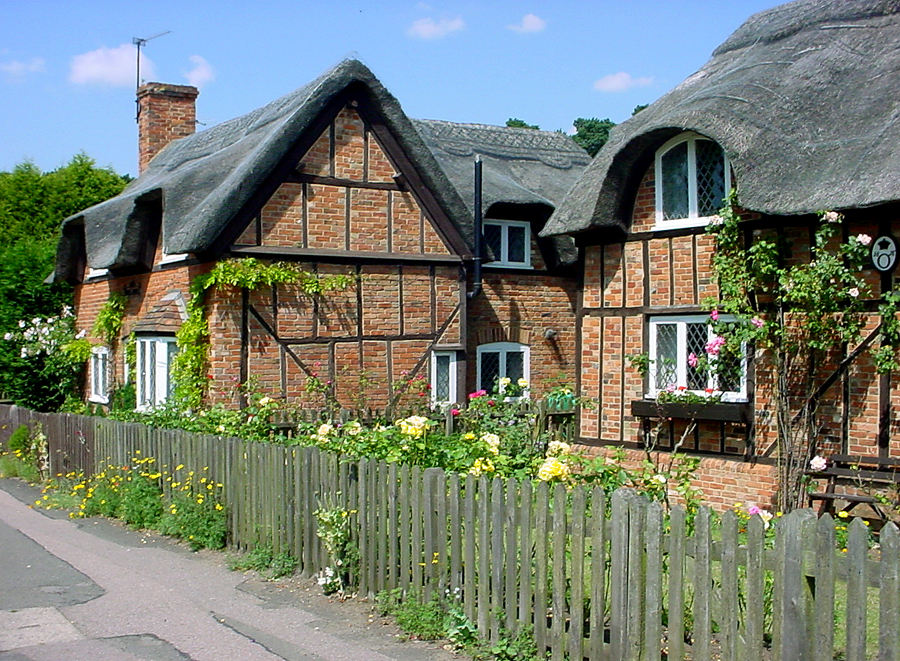
Cottages in Woburn Street, Ampthill (built around 1812-1816)
Charles Abbis (1833-1913)
My direct ancestor was Thomas and Sarah's son, Charles Abbis, who was born in 1833. He worked as blacksmith, wheelwright and undertaker initially in Ampthill, but he moved to Harlington sometime during the 1850s. He married twice. His first wife, Mary Grimes Prestidge, was a lace maker from Northamptonshire. She later worked as a dress maker. They had six children. Mary died at the age of 40. Within less than a year, Charles married again to Frances Busby. In every censuses between 1861 and 1911 Charles' occupation was blacksmith in Sundon Road, Harlington. He was described as the village blacksmith in every trade directory from 1862 until his death in 1913. He left a Will which appointed his sons Walter Charles Abbis and Harry Prestage Abbis as executors. He left his estate divided equally between his six children. The gross value of the estate was £385, the net value was £92.
Walter Charles Abbis (1853-1938)
Walter and Harriet had ten children. The eldest, Elizabeth, moved to London and was a 16 year old domestic servant in the household of Luke Dancer, a dairy farmer in Fulham, West London, in 1891. In 1897 she married John Leatherland. She died in 1908 leaving four sons. The next child, Annie, was born in Islington in 1878. It is not clear why her mother was in London at this time. The 1901 census shows Annie was a 22 year old domestic parlour maid in Birmingham living in the household of Mary Johnson and her son John Butlin of Pakenham Road, Edgbaston. John Butlin was a solicitor. I understand that John E. Leatherland later worked for the Butlin family. The 1911 census shows that Annie was still a domestic parlour maid domestic in John Butlin's household. By then he was living in Somerset Road, Birmingham. Annie later probably married John Jones in Manchester (1928).
Another daughter, Kate Abbis (born 1880) married William Bentley in Ampthill in 1904. They settled in Harpenden and had three sons. The next child, Frederick Abbis (born 1883) moved to Cheshire and married Beatrice Raybould in 1906. The 1911 census says that he was a waterworks labourer in Altrincham, Cheshire. They had two children although one died in infancy. George Abbis was born in 1884. In 1901 he was a 17 year milker on a farm in Harlington. In 1911 he was a 27 railway platelayer in Cricklewood, North West London. He married in 1907 and had two sons , Edward and Walter Abbis. I understand that George lived into his 90s. His sons died in Camden and in Cambridge in the mid 1980s.
Harry Abbis was born in 1890. He was an 18 year old station coal porter in 1911. My great uncle told me that he worked on Mr Richardson`s farm in Harlington and later as a machinist in Mr Gillam`s straw-hat factory in Luton. Harry enlisted in the Bedfordshire Yeomanry on 1 November 1914. After this was broken up, he served with the Lincoln & East Ridings Yeomanry in Ireland and Egypt. He served in France with the Machine Gun Corps. He was present at the taking of Valenciennes and Famiers. Harry was killed at his gun by enemy shelling on October 26 1918 two weeks before the Armistice. He is commemorated on the Harlington village war memorial.
The last child of Walter and Harriet Abbis, William (known as Billie) was born in 1894. He married Florence Pett and lived into his 80s. They had five children : Marjorie who became a missionary and married Service Farrant, Vida who married John Walker and remained living in Ampthill, Geoffrey who also became a missionary, Myra a nurse who married Gerald Martin, and Trevor Abbis who married Eunice Walker.
Abbis in Local Trade Directories
Pigot's Directory of 1839 listed the three Abbis brothers, Richard, Thomas and
William as blacksmiths in Ampthill. The Post Office Directory for 1847 also
listed Richard, Thomas and William Abbis, the first two being classed as
'shoeing smith'. The Post Office Directory for 1864 listed : George
Abbis, blacksmith of Dunstable Road, Ampthill Mrs Sarah Abbis, blacksmith,
Woburn Street Thomas Abbis, beer retailer, Dunstable Street William Abbis,
Compasses, Dunstable Street William and George Abbis, coach builder, Woburn
Street Melville's Directory of 1867 listed the following Abbis's in Ampthill :
Frederick Abbis,blacksmith, Woburn Street. George Abbis, beer retailer, Dunstable Street. John Abbis, farrier and general smith, Dunstable Street. Thomas Abbis, beer retailer, Dunstable Street. Mrs Sarah Abbis, general .smiths, Woburn Street. William Abbis, blacksmith. George Inn, Woburn Street
Blacksmiths
Blacksmiths are usually associated with making shoes for horses, but a nineteenth century blacksmith played a key role in the village as a metal worker making objects from iron or steel by forging the metal and using tools to hammer, bend, and cut it. Blacksmiths would make many items in the forge : wrought iron gates, grills, railings, light fixtures, furniture, tools, agricultural implements, decorative and religious items, cooking utensils, horseshoes and even weapons. But much of the blacksmith's work was based around horses. Horses were an essential part of the local economy until the invention of the motor car. Carriers carried goods between places using horse and cart, people would travel on horseback or in horse-drawn carts, farmers used horses to pull ploughs, carts and waggons, there were even horse-drawn buses in some towns. The blacksmith not only made and fitted shoes for horses, he also made parts for their harnesses, stirrups for their riders, and fittings for carts and waggons. (A blacksmith who specialized in making and fitting horseshoes came to be called a "farrier").
Origins of the Abbis Surname
Early examples of the surname recordings include the marriage of Jane Abbis and Robert Lawter, at Covehithe in Suffolk (1611), the christening of James, son of Robert and Jane Abbiss (1690) at St. Mary Woolnoth, London, and the marriage of William Abbes and Sarah Page, at Great Yarmouth, in 1724. A notable bearer of the name was William Abbys, mayor of Bedford in 1534. The first recorded spelling of the family name is said to be that of John Abbys in 1480, recorded in the medieval rolls of Norfolk.
The Bedfordshire and Luton Archives and Records Service has an excellent on-line index which reveals the existence of the Andrew Underwood collection which includes some detailed Abbis family history.
My great uncle John Henry Leatherland wrote his childhood memories of holidays in Harlington as a boy during the First World War. These recollections were published by the Harlington Heritage Trust and by kind permission of the Trust Chairman, I reproduce these below :
"One day (in I think 1915), 3 or 4 other boys and myself were walking along the bottom of the railway embankment towards Sundon, when one of the boys surprised a rabbit. He endeavoured to catch it by falling on it, was successful and dispatched it in the usual way. Then followed a discussion on how this boy was to get the rabbit home, it being explained to me that if caught with it, he could be charged with poaching. The solution was to pick some blackberries and thoroughly stain a large handkerchief and tie the rabbit in it. (Actually it was a large piece of rag - it was unusual for working class boys to have a proper handkerchief, except on Sundays). All went well, we met neither farmer nor policeman, nor anyone else in authority, which was probably just as well, undoubtedly they hadprevious experience of this piece of subterfuge."
"Mention of Sunday takes me on to one of the first personal questions I was asked by Harlington boys, namely was I a Church 'un or a Chapel 'un ? They were anxious that I should go to the right place for Sunday School, do the right things, say the right responses, etc. Being C. of E. I went to the same Sunday School as the boy who "poached" the rabbit."
"Rabbits takes me to harvest time 1917. Hravesting then was of course done by horse drawn cutter/binder, the sheaves being stacked in stooks of 8 or 10 sheaves and left for 2 or 3 weeks for the ears to dry out. This of course was men's work ; there was quite a bit of experience needed to make a stook that would not collapse even in a modicum of wind. We boys thought harvest time was great fun, especially when the last few yeards of corn was being cut and all the small animals, who had kept moving inwards away from the reaper, burst out trying to escape. Usually there might be a dozen or two but, in this field, on this occasion, the number caught filled three-quarters of a milk float. I do not know how the farmer disposed of them, but undoubtedly there were many village families who had their war rations supplemented."
"During my holiday fortnights there was always a picnic. Grandmother, a couple of aunts, various cousins and two or three neighbours would make for the Clappers laden with baskets, bags, pots and kettles. We did not take water as that could be obtained from a pure spring source in a lane off to the left of Sundon Road and at the foot of the climb up to the Clappers. I doubt if that spring is still there but, if it is, I would doubt that it is fit to drink." [The Sharpenhoe Clappers is a local hilly woodland area].
Another annual event was when Grandfather [Walter Charles Abbis] would take the family, and a neighbour friend or two of Grandmother's, for a ride in a wagonette to Woburn Abbey. Although the house and park were not open to the public, the old duke allowed (respectable) locals to walk or drive through the deer park."
"There was a Chalk Pit about half way up Sundon Hill. I was told that it had originally supplied lime to the Sundon Cement Works, but at the time of my holidays seemed only to be used by local farmers wanting lime for their fields. A two-wheel farm wagon full of lime was very heavy, and a horse could not hold it back on that steep bit of hill. So, in addition to metal shoes slipped under the wheels, a piece of tree trunk about 6 or 8 inches in diameter, was hooked over the axletree and the body of the wagon about half tipped so that much of the weight rested on this trunk, the end of which formed an effective brake as it dragged on the road surface."
"There may be places and occasions when the same method is used today, in fact it might still be used at Harlington if the chalk pit is still in use. The joy of the chalk pit for us boys was, however, that it was marvellous for sledging. Any old bit of plank, piece of corrugated iron, old box or tin tray was good enough for a sledge. When the chalk was perfectly dry or when the surface was slightly damp it was, to us, perfect. Mothers, and grandmothers, sad to relate, took an entirely opposite view !"
"My Aunt Annie {Abbis} told me on one occasion of a special train journey, which must have happened about the turn of the century. An uncle, who was working up north, was taken ill and the grandparents decided to despatch Annie to make sure he was being properly looked after. Annie consulted the Station Master about the quickest way to get to her destination ; she thought she might travel forward to Bedford by stopping the train and picking up the express there. She was told, however, that it did not stop until Leicester, but he would try to get the express stopped at Harlington. In this he was successful, the exact stopping place for the engine was indicated on the platform, as was the place Auntie Annie was to stand, with the Station Master behind her. The enginestopped with a screeching of brakes and blowing of steam. Aunt says she was literally pushed into the carriage, while lower down the platform, her trunk was thrown into the guards van and the train was moving again before you could say Jack Robinson."
"I cannot imagine Aunt Annie making up this story, she was a very "correct" and intelligent lady, and not at all the sort of person to indulge in make-believe."
After the death of my great grandmother, my great grandfather John Edward Leatherland advertised for a housekeeper to look after his four young boys. Rosina Atkins applied, got the job and later married him.
Rosina was born in Lambeth in 1871. She was the daughter of William John Atkins a portmanteau (suitcase) maker from Battersea. Rosina worked in the family business and can be found in the 1891 census employed as a dye stamper. By 1901 she had left home and was living in Barnstaple, Devon working as a bar attendant at the railway station. Later she became manageress of a railway station buffet.
The Atkins family ran a portmanteau making business. Rosina's father was born in 1884 and married Sarah Bell at St Martin in the Fields (the church by Trafalgar Square). Most of Rosina's brothers joined the family business.
www.achome.co.uk/antiques/vintage_luggage.htm lists 1930s luggage makers Edwin Alex Atkins and Frederick Walter Atkins who may well be descendants.
The STECHMANNS of Shoreditch
My Auntie Esther who married my uncle, John Leatherland, has ancestors who originated from Germany and emigrated to London during the mid nineteenth century.
The earliest ancestor traced is Peter Stechmann and his son Jacob who emigrated from Germany to London sometime during the mid nineteenth century. Peter Stechmann was born in Hanover about 1814. Jacob was born around 1844, also in Hanover. It is believed that the family came from Altesland near Hamburg on the south side of the River Elbe, that they were a farming family, and that the distant family origins were Dutch.
The name is believed to come from Steg-Mann meaning 'the people living at the bridge'. The Altes Land area belonged to the former kingdom of Hannover, which at one time was part of Prussia. [This information comes from Dr Dirk-Heinrich Stechmann, via Carol Stechmann].
The Stechmanns first appear in the English census in 1871. Jacob was living in Milton Street, St Giles Without Cripplegate, in London. His surname was spelt Stickmann. He was a visitor in the household of Heinrich and Sophia Pohlmann. It is interesting to note that there were six other visitors in the house all born in Germany. Heinrich's occupation was a "tip and tazzle manufacturer" who employed 8 men {I have not yet found out what this was, although a tassler made tassells for furniture}. Jacob Stickmann was a tailor. Peter Stechmann has not yet been traced in this census.
In December 1871 Jacob Stechmann married Amalie Bethke in the City of London. Amalie is said to have been an au pair from Austria who worked for the household of a family who ran a tailoring business. However, the 1881 census says that she was from Stettin, Pomerania which is on the East German/Polish boarder and now part of Poland. Jacob and Amalie had five sons and one daughter.
By 1881 Jacob Stechmann and his father, Peter, lived at Clifton Street, Shoreditch. For some reason the family gave their surname as Hulchings in the 1881 census, except for the father Peter whose name is spelt as Steitchmann. A trade directory of 1882 lists him as Jacob Steachman, tailor. By 1891 the family was still living at Clifton Street, Shoreditch with their children and running their tailoring business. The name is spelt Steitchmann. Peter, the father, died in the German Hospital in Dalston in 1883. He was 68 and a farm labourer, probably at Hackney City Farm. Jacob died in Shoreditch in 1893 at the age of 48. Amalie carried on the family tailoring business. In 1901 the family were still living in Clifton Street, Shoreditch. The surname was now shown as Stechmann. She employed several workers.
The 1911 census shows Almelia Stechmann now aged 61 living at Dysart Street, Finsbury with her son Fred, a hairdresser's assistant. Three lodgers, one servant and a machinist lived in the household. The machinist was described as making trousers, she was from Holland.
One of Jacob and Amelia's sons was Henry Charly Stechmann born in 1881 in Shoreditch. In the 1901 census he was living with his mother. He was a hairdresser’s assistant. A 1902 trade directory lists Charles as a hairdresser at Club Union Buildings, Clerkenwell. He was known as Charles (or Coola). He married Sister Frederica Webster (known as Cissy) in 1901.
In the 1911 census, Charles Stechmann was living in Hoxton Street with his wife and five children, inlcuding a nine day old baby. There were two boarders in the household, both bakers from Germany. Cissy died of TB in 1915 in Walthamstow aged 35.
Other children of Jacob and Amelia include Hermann Charles who married Louisa Miles in Shoreditch. When Louisa died aged 26 and the children were put into a National Children’s Home. Herman was a champion swimmer and boxer and a hairdresser like several other relatives. His second marriage was to an Irish girl, Margaret Josephine Mangan.
Henry Charly and Cissie Stechmann had several children. One of them - Dora Bertha born 1908 in Shoreditch – was my aunt's mother. She had two daughters Bertha (Bet) and Esther (my aunt). She later married James Thomas, a merchant seaman in 1933 and they had a daughter Marie. After his death during the Second World War, she remarried and had two more daughters. Henry Charly died in London in 1968 at the age of 86.
[I am indebted to Carol Stechmann, grandaughter of William Stechmann - Henry Charly's brother - who provided much of this information, and also to Julie Moores, a descendant of Cissie Webster.]